




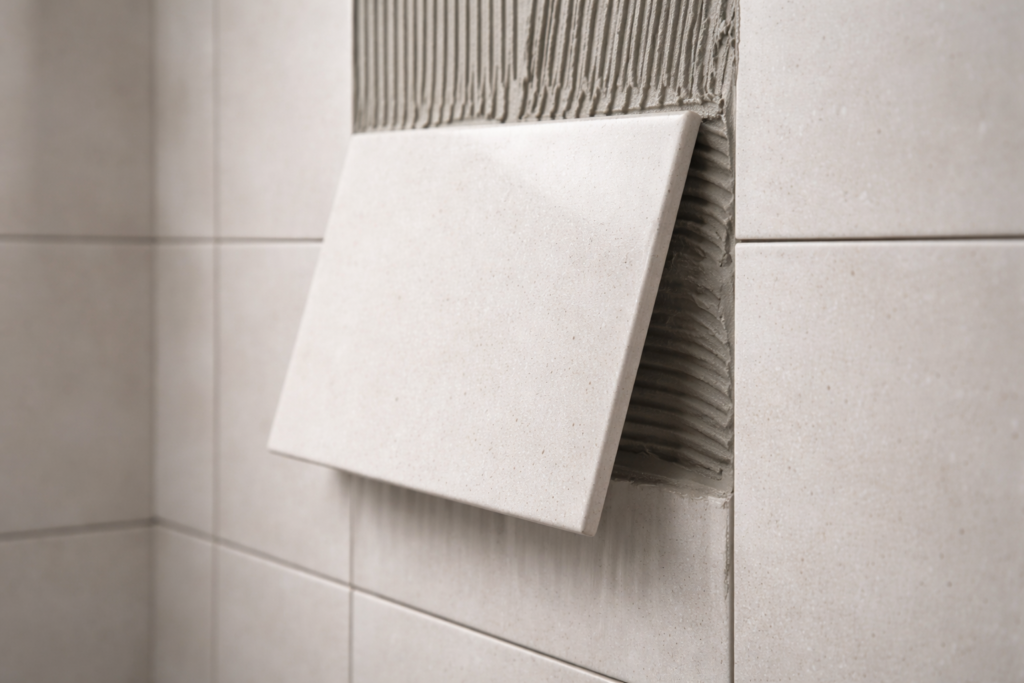
You’ve probably seen it happen on-site.
A freshly installed wall tile slowly sliding down…
A slight misalignment that worsens by the hour…
Or worse – tiles detaching weeks after installation.
At first, it feels like a minor execution issue.
But here’s the reality:
Vertical tiling failures are rarely about skill – they’re about physics.
And more specifically:
How well your adhesive can resist gravity.
Because unlike floors, walls don’t give you a second chance.
The Real Challenge of Vertical Tiling
Floor tiles rely on support.
Wall tiles fight against it.
Every tile installed vertically is under constant downward force. That means your adhesive must do two things simultaneously:
- Hold the tile instantly (initial grip)
- Maintain long-term bond strength
Where Things Go Wrong
Most failures occur when:
- The adhesive lacks anti-slip properties
- Tile weight exceeds bonding capacity
- The surface is too smooth or poorly prepared
This is exactly why professionals rely on non-skid adhesive for vertical wall tiling, because standard adhesives simply aren’t engineered for this kind of stress.
Understanding Non-Slip Technology (Without the Jargon)
Let’s break it down simply.
A non-skid (or non-slip) adhesive is designed with thixotropic properties.
In plain terms:
- It spreads easily when applied
- But becomes firm once the tile is placed
Why This Matters
- Prevents tiles from sliding downward
- Maintains alignment without constant adjustments
- Reduces the need for spacers and support systems
The Balance That Matters
A good vertical adhesive must balance:
- Workability (easy to apply)
- Grip (holds tile instantly)
Too fluid → tiles slip
Too stiff → difficult application
Common Site Mistakes in Wall Tiling
Even experienced teams make these errors, especially under time pressure.
1. Using Floor Adhesive on Walls
- Not designed for vertical load
- Leads to gradual tile slipping
2. Incorrect Adhesive Thickness
- Too thick → uneven grip
- Too thin → weak bonding
3. Poor Trowel Technique
- No proper grooves = air pockets
- Reduces the bonding area
4. Ignoring Tile Size & Weight
- Larger tiles = higher gravitational pull
- Requires a stronger adhesive
5. Working Too Fast Without Setting Time Awareness
- Adjusting tiles after the adhesive begins setting
- Weakens bond integrity
Standard Adhesive vs Non-Skid Adhesive
| Parameter | Standard Adhesive | Non-Skid Adhesive |
| Tile Slip | High | Minimal |
| Initial Grip | Moderate | Strong |
| Vertical Stability | Weak | High |
| Ease of Alignment | Difficult | Easy |
| Suitability for Large Tiles | Limited | Excellent |
What Professionals Do Differently
The difference between average and expert installation is not just skill – it’s system thinking.
✔ They Match Adhesive to Application
- Wall ≠ Floor
- They choose purpose-built materials
✔ They Work in Controlled Sections
- Avoid large area application at once
- Maintain adhesive performance
✔ They Use Proper Application Tools
- Notched trowels
- Correct groove patterns
✔ They Respect Open Time & Setting Time
- No over-adjustment
- No delay in tile placement
✔ They Plan for Tile Load
- Especially in:
- Large format tiles
- Decorative wall panels
- Stone cladding
How to Ensure Perfect Wall Tiling (Quick Checklist)
Before you begin, evaluate:
Tile Type & Size
- Standard ceramic vs large format tiles
Surface Condition
- Smooth/rough/painted/plastered
Adhesive Type
- Always choose non-skid for vertical applications
Environmental Conditions
- Temperature
- Humidity
Application Method
- Use the correct trowel size
- Ensure full adhesive coverage
The Bigger Insight: Wall Tiling Is Physics, Not Just Practice
Here’s what most people miss:
Tiles don’t fall because they were installed incorrectly.
They fall because the system wasn’t designed for vertical stress.
When you understand:
- Load
- Grip
- Adhesion mechanics
You stop guessing – and start engineering your installation.
Conclusion: The Right Adhesive Doesn’t Just Stick – It Holds
In vertical tiling, there are no shortcuts.
You either:
- Choose the right system
- Or deal with failure later
Because once tiles start slipping or detaching:
- Repairs are costly
- Reputation takes a hit
- And trust is lost
So, the next time you approach a wall tiling project, remember:
It’s not about placing tiles.
It’s about controlling gravity.
And that starts with choosing the right adhesive.