




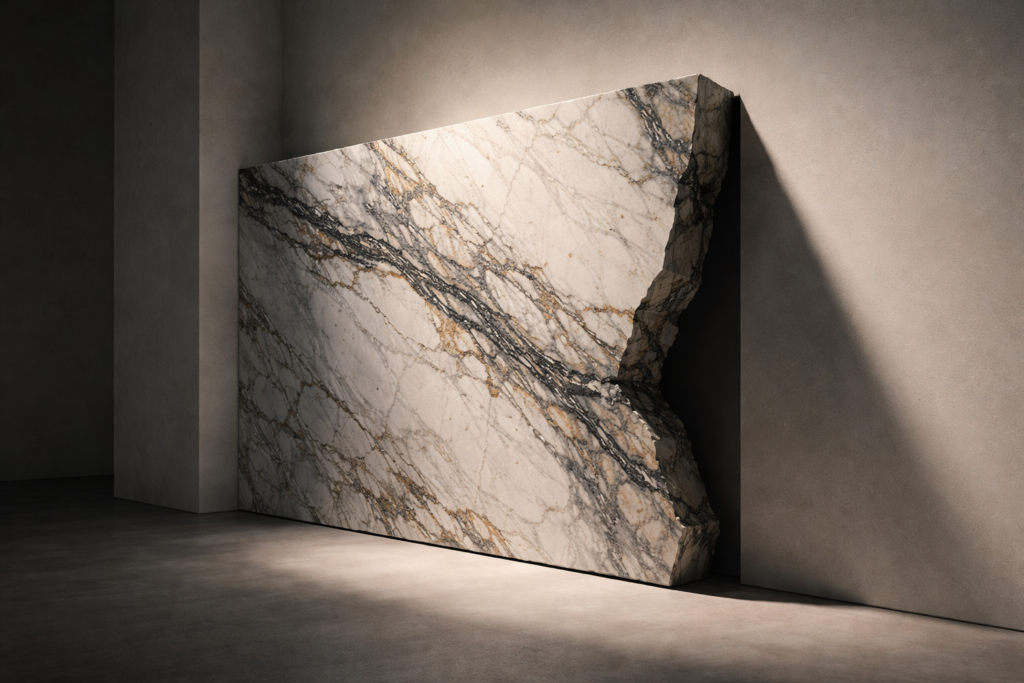
Tiles slipping is frustrating.
But natural stone falling off a wall?
That’s not just a defect – it’s a liability.
- Heavy slabs detaching
- Cracked edges
- Damaged interiors
- Safety risks
And the worst part?
It often happens weeks or months after installation – when everything looked perfect.
Most people blame:
- Poor labour
- Low-quality stone
But the real issue is deeper:
Natural stone doesn’t fail randomly. It fails when treated like ordinary tile.
The Real Challenge with Natural Stone on Walls
Natural stone is not ceramic.
It doesn’t behave uniformly.
And it certainly doesn’t forgive mistakes.
What Makes Stone Difficult?
- Weight → Much heavier than standard tiles
- Porosity → Absorbs moisture unevenly
- Surface Irregularities → Not perfectly flat
- Size Variations → Inconsistent thickness
The Core Problem
You’re trying to fix a heavy, irregular, absorbent material onto a vertical surface.
This is exactly why professionals use a dedicated adhesive for fixing natural stone on walls, because standard solutions are simply not engineered for this load.
How Natural Stone Behaves Differently Than Tiles
Understanding this is where most failures are prevented.
1. Uneven Absorption
- Stone absorbs adhesive moisture differently
- Leads to inconsistent bonding
2. Warping & Stress
- Moisture imbalance can cause slight deformation
- Weakens adhesion over time
3. Load Distribution Issues
- Weight is not evenly distributed
- Creates stress points
4. Surface Contact Challenges
- Uneven backs → incomplete adhesive contact
- Voids = failure zones
The Key Insight
Stone doesn’t just need adhesion – it needs load management.
Common Mistakes in Stone Installation
This is where most projects go wrong.
❌ Using Standard Tile Adhesive
- Not designed for heavy materials
- Insufficient bonding strength
❌ Skipping Back-Buttering
- No adhesive on the tile back
- Leads to hollow gaps
❌ Ignoring Weight Factor
- Large stones need higher grip strength
- Gravity impact underestimated
❌ Uneven Adhesive Application
- Creates voids behind the stone
- Weakens structural hold
❌ No Mechanical Support (When Needed)
- Large slabs require additional support systems
Tile Adhesive vs Stone Adhesive
| Parameter | Tile Adhesive | Stone Adhesive |
| Load Capacity | Moderate | High |
| Bond Strength | Standard | Enhanced |
| Grip on Vertical Surfaces | Limited | Strong |
| Suitability for Heavy Material | Low | High |
| Long-Term Stability | Risky | Reliable |
What Professionals Do Differently
This is where real expertise shows.
✔ They Treat Stone as a Structural Element
Not just decorative –
but load-bearing on a vertical plane
✔ They Use High-Strength Adhesive Systems
- Designed for:
- Heavy load
- Vertical grip
- Long-term stability
✔ They Apply Dual Bonding (Critical)
- Adhesive on:
- Wall
- Stone back
This ensures:
100% contact = 100% strength
✔ They Plan Installation Strategically
- Work in sections
- Support heavier pieces during setting
✔ They Check Surface Integrity
- Wall must be:
- Strong
- Even
- Crack-free
How to Choose the Right Stone Installation Method
Before starting, evaluate:
🔹 Type of Stone
- Marble / Granite / Sandstone / Quartz
🔹 Size & Thickness
- Larger & thicker = higher load
🔹 Wall Condition
- Plaster quality
- Structural strength
🔹 Environment
- Indoor/outdoor
- Moisture exposure
🔹 Adhesive Requirement
- Must support:
- Weight
- Surface irregularities
- Vertical hold
The Bigger Insight: Natural Stone Needs Engineering, Not Just Installation
Here’s the mindset shift:
Tiles are installed.
Stone is engineered into place.
Because when you ignore:
- Load
- Material behaviour
- Adhesive strength
You don’t just risk failure; you assure it.
Conclusion: If It’s Heavy, It Needs More Than Just Adhesive
Natural stone failures are not random. They are predictable and preventable.
The difference lies in:
- Understanding the material
- Choosing the right adhesive system
- Applying the correct technique
Because at the end of the day:Stone doesn’t fall because it’s heavy.
It falls because the system holding it isn’t strong enough.