




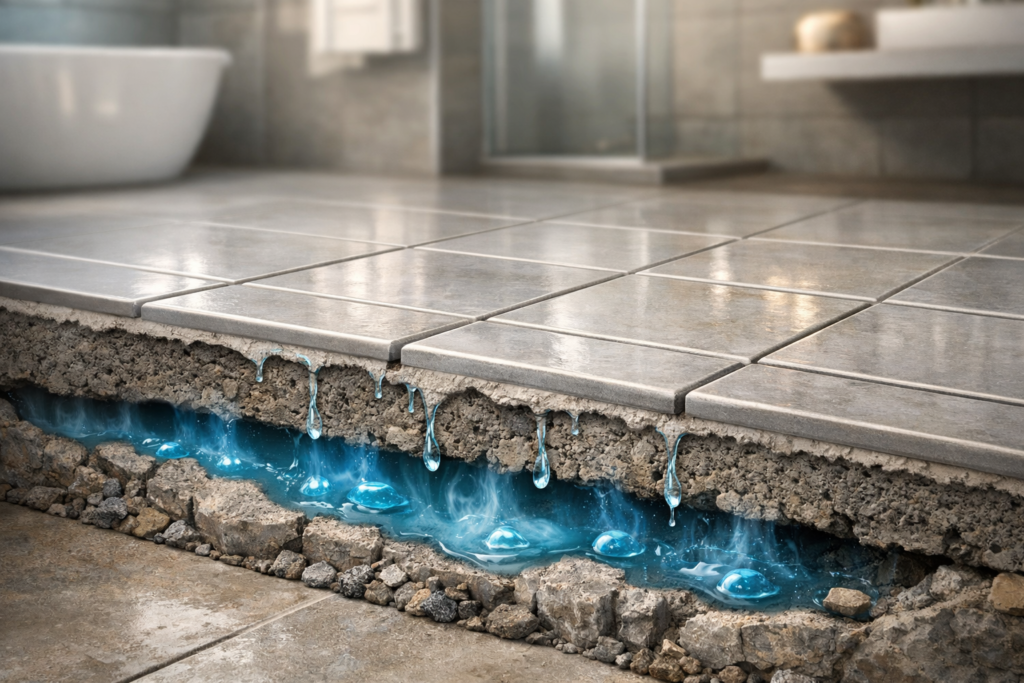
Bathroom tiles don’t fail dramatically. They fail quietly.
A slightly darkened grout line.
A faint hollow sound beneath your feet.
A tile that feels “just a little loose.”
And before you realise it—
the problem has already spread beneath the surface.
Most people blame: “Poor tiles” or “bad workmanship.”
But here’s the truth most sites won’t tell you:
In wet areas, failure doesn’t start from the top. It starts from beneath.
Because water doesn’t attack tiles.
It attacks the bonding system holding them together.
The Real Enemy: Constant Moisture Exposure
Unlike dry areas, bathrooms and kitchens operate under continuous stress conditions:
- Daily water exposure
- Steam and humidity
- Temperature fluctuations
- Chemical exposure (soaps, cleaners)
What This Means Practically
Your tile system is never truly “dry.”
And that changes everything.
Where Most Installations Go Wrong
- Using standard adhesive instead of moisture-resistant systems
- Ignoring waterproofing layers
- Improper curing before exposure to water
This is exactly why professionals rely on tile adhesive for wet area applications—because these spaces demand more than just bonding. They demand resistance.
How Water Actually Affects Tile Bonding
Let’s break the science into something practical.
1. Capillary Action (The Silent Intruder)
Water seeps through:
- Grout lines
- Micro gaps
- Edges of tiles
Once inside, it starts affecting the adhesive layer.
2. Adhesive Breakdown Over Time
Standard adhesives:
- Absorb moisture
- Lose bonding strength gradually
- Become brittle or weak
3. Expansion & Contraction Cycles
- Moisture + temperature = movement
- Repeated cycles weaken adhesion
4. Mold & Fungal Growth
- Damp environments = biological growth
- Leads to discoloration + health risks
The Key Insight
Water damage is not sudden – it’s cumulative.
And by the time it becomes visible,
the bonding system has already failed.
Common Mistakes in Wet Area Tile Installation
Even well-executed projects fail due to small oversights.
❌ Using Regular Adhesive
- Not designed for water resistance
- Weakens over time
❌ Skipping Waterproofing Layer
- Water directly reaches substrate
- Accelerates damage
❌ Poor Grouting Practices
- Gaps allow water entry
- Improper sealing
❌ Rushing the Curing Process
- Adhesive not fully set before exposure
- Leads to early failure
❌ Ignoring Drainage Slope
- Water accumulation increases stress
Standard Adhesive vs Wet Area Adhesive
| Factor | Regular Adhesive | Wet Area Adhesive |
| Water Resistance | Low | High |
| Bond Durability | Moderate | Long-lasting |
| Resistance to Moisture Cycles | Weak | Strong |
| Suitability for Bathrooms | Risky | Ideal |
| Long-Term Performance | Unstable | Reliable |
What Professionals Do Differently
Here’s where expertise shows.
✔ They Treat Wet Areas as High-Risk Zones
Not just another room – but a controlled environment requiring precision
✔ They Use a System, Not Just a Product
- Waterproofing layer
- Moisture-resistant adhesive
- Proper grout
✔ They Respect Curing Time
- No early exposure to water
- Ensures full bonding strength
✔ They Choose the Right Adhesive Grade
- Based on:
- Tile type
- Area usage
- Moisture exposure
✔ They Ensure Full Adhesive Coverage
- No voids = no water pockets
Wet Area Installation Checklist (Quick Guide)
Before installation, evaluate:
🔹 Substrate Condition
- Dry, stable, crack-free
🔹 Waterproofing Applied?
- Mandatory for bathrooms
🔹 Adhesive Type
- Must be suitable for wet areas
🔹 Tile Type
- Porcelain / ceramic / natural stone
🔹 Drainage Planning
- Proper slope for water flow
🔹 Curing Time
- Minimum recommended wait before water exposure
The Bigger Insight: Bathrooms Are Engineering Zones
Most people treat bathrooms like any other room.
Professionals don’t.
They treat them as water management systems.
Because in wet areas:
- Bonding is constantly under attack
- Materials are under stress
- Small mistakes become expensive failures
Conclusion: Water Finds Weakness. Your System Shouldn’t Have One.
Tile failure in bathrooms is not accidental. It’s predictable. And preventable.
The difference lies in:
- Understanding moisture behaviour
- Choosing the right adhesive system
- Following the correct installation process
Because in the end: Tiles don’t fail in wet areas. Weak systems do.