




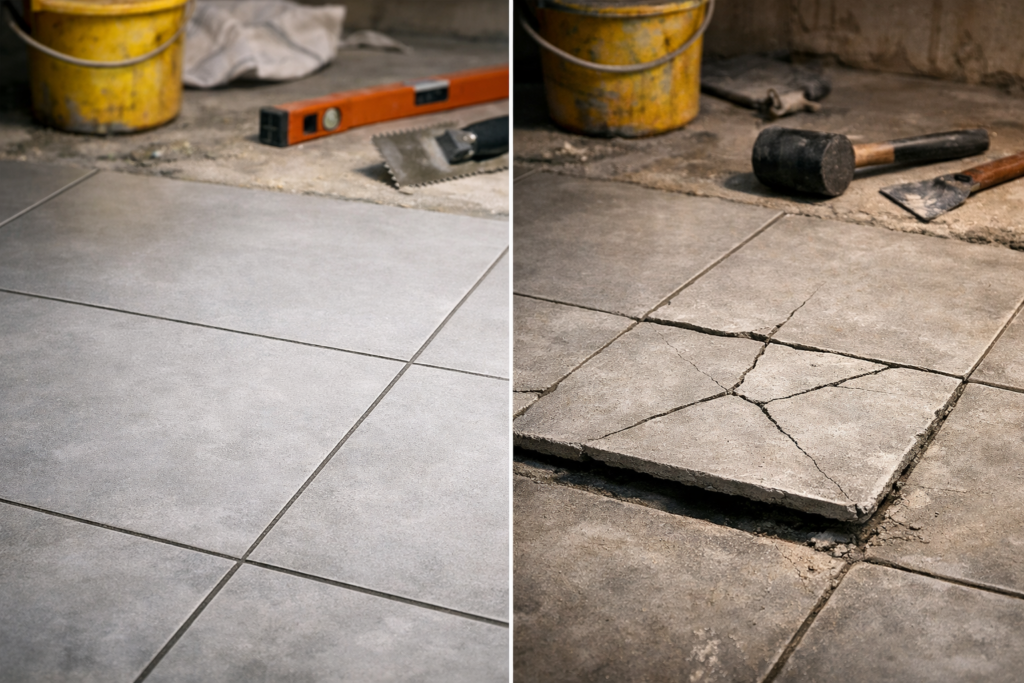
Tiles Don’t Fail Overnight. They Fail Silently.
It usually starts small.
A slightly loose tile.
A faint hollow sound when you tap it.
Maybe a crack that wasn’t there a month ago.
You fix it quickly. Replace one or two tiles. Job done.
But then – within weeks or months – it happens again.
Same spot. Same issue. Same frustration.
At this point, most people assume: “The tile quality must be poor.”
But here’s the uncomfortable truth: Tile failures in repair jobs are rarely about tiles. They’re about bonding.
And more specifically, how repairs are done – not just what is used.
The Real Problem Behind Failed Tile Repairs
Repair work is fundamentally different from fresh installation.
You’re not working with a clean, controlled surface. You’re dealing with:
- Old substrates
- Residual adhesive or cement
- Micro-cracks and dust
- Uneven surfaces
- Hidden moisture
In simple terms:
You’re trying to bond new material onto a compromised base.
This is where most repairs fail.
The Core Issue: Weak Adhesion on Existing Surfaces
Traditional methods, especially cement mortar, are not designed for this.
They:
- Require strong mechanical grip
- Don’t adapt well to uneven or aged surfaces
- Take longer to set (leading to movement during bonding)
That’s why professionals today increasingly rely on fast-setting tile adhesive for quick home repairs because repairs demand speed and strength, not just filling.
How Bonding Actually Works in Repair Situations
Let’s simplify the science.
Fresh Installation:
- Adhesive bonds directly to a prepared substrate
- Uniform surface = strong bonding
Repair Work:
- Surface is inconsistent
- Adhesion must compensate for imperfections
This is where polymer-modified adhesives come into play.
They:
- Create chemical bonding (not just mechanical grip)
- Adapt to minor surface irregularities
- Set faster, reducing the risk of displacement
Setting Time vs Curing Strength (Important Distinction)
- Setting Time → How quickly the tile stays in place
- Curing Time → When full strength is achieved
In repair scenarios:
Faster setting = less movement = stronger long-term hold
Common Mistakes Contractors Make During Repairs
Even experienced contractors can overlook key details in “small jobs.”
1. Using Cement Mortar for Repairs
- Works for base construction—not precision repair
- Poor adhesion on old surfaces
2. Ignoring Surface Preparation
- Dust and debris weaken bonding instantly
- No cleaning = no adhesion
3. Not Accounting for Time Constraints
- Repairs are often rushed
- Slow-setting materials fail under pressure
4. Reinstalling Over Weak Substrates
- Loose base = repeated failure
- Surface integrity is critical
5. Incorrect Adhesive Thickness
- Too thick → uneven bonding
- Too thin → insufficient grip
Traditional Repair vs Modern Adhesive Approach
| Factor | Cement Mortar | Fast-Setting Tile Adhesive |
| Setting Time | Slow (hours to days) | Rapid (within hours) |
| Bond Strength | Moderate | High |
| Suitability for Repairs | Low | High |
| Surface Adaptability | Poor | Excellent |
| Risk of Rework | High | Minimal |
What Professionals Do Differently
Experienced applicators don’t treat repairs as “small work.”
They treat them as precision work.
Here’s how:
✔ They Choose the Right Material
- Use adhesives designed for repair—not general use
✔ They Reduce Downtime
- Faster setting = quicker usability
- Ideal for homes, commercial spaces, and urgent fixes
✔ They Focus on Long-Term Hold
- Not just fixing the tile
- Fixing the cause
✔ They Prepare the Surface Properly
- Cleaning
- Leveling
- Ensuring bonding conditions are ideal
How to Choose the Right Repair Solution (Quick Checklist)
Before starting any tile repair, ask:
What is the surface condition?
- Clean / dusty / cracked
How urgent is the repair?
- Immediate use required?
→ Choose fast-setting solution
What type of tile is being installed?
- Ceramic / vitrified / stone
Is the area exposed to moisture or load?
- Bathroom / kitchen / high traffic
Is the substrate stable?
- If not, fix base before bonding
The Bigger Insight: Repairs Are Not Small Jobs
Here’s the shift in thinking:
A repair is not about replacing tiles.
It’s about restoring structural bonding.
And that requires:
- The right material
- The right method
- The right understanding
Because in construction:
What you don’t see (bonding) decides what you do see (failure).
Conclusion
Tile repairs fail when they are treated casually.
They succeed when they are treated technically.
The difference lies in:
- Understanding the surface
- Choosing the right adhesive system
- And respecting the science behind bonding
Because in the end:
A strong repair isn’t about speed—it’s about smart execution.